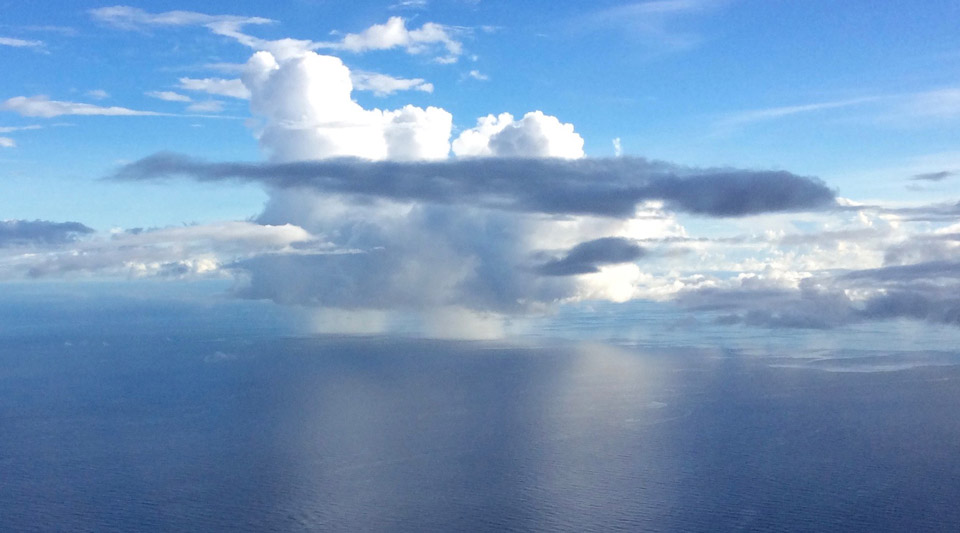
Before the Industrial Revolution, the world’s oceans exchanged roughly equal amounts of carbon dioxide with the atmosphere. Today, by absorbing a significant share of human-generated CO₂ emissions, they play a vital role in slowing the buildup of this greenhouse gas in the atmosphere.

The agitating power of wind has played a central role in models estimating the rate at which carbon dioxide moves between ocean and atmosphere. But a study in Nature Geoscience, co-authored by Wade McGillis, professor of civil and environmental engineering and earth sciences at the University of Notre Dame, shows that rain also plays a significant role in this exchange. In fact, when the researchers added the effects of rain to their model, the estimated amount of carbon dioxide absorbed by the ocean increased by 13.6%. The finding could help scientists more accurately account for the ocean’s role in the global carbon cycle and ultimately improve climate projections.
While the world’s oceans are vast and miles deep, the exchange of carbon dioxide with the atmosphere occurs across a microscopic boundary at the ocean’s surface. Rain creates a layer of fresher water in the upper few meters of the ocean that alters the water’s chemistry in a way that facilitates carbon exchange.
“When rain falls through the atmosphere, it scoops up atmospheric carbon dioxide that it then injects into the ocean,” said McGillis. “When the rain hits the ocean surface, the transfer of CO₂ between the atmosphere and ocean increases—like opening a window to ventilate a room.”
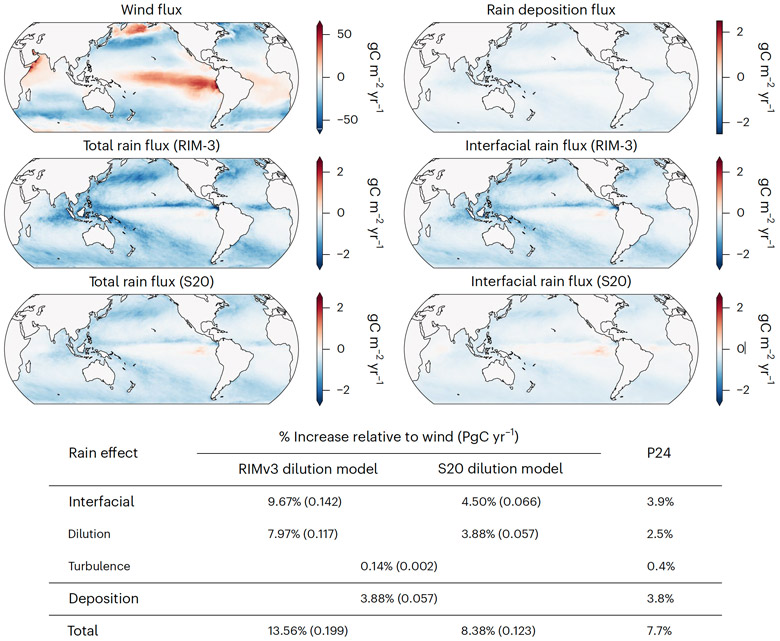
Rain affects carbon exchange by creating turbulence at the ocean’s surface, helping gases move between air and water. With each drop, it also carries dissolved carbon dioxide directly into the ocean.
But previous models underestimated a third effect—the ability of fresh rainwater to dilute the salty water at the ocean’s surface, creating chemical conditions that favor greater uptake of atmospheric carbon dioxide. The researchers found that this dilution effect accounts for about two-thirds of the additional carbon uptake caused by rain.
Some regions of the world’s oceans are net sinks of CO₂—they absorb more than they release. Other areas are net sources—they release more than they absorb. Yet the team found that across nearly the entire globe, rain shifts CO₂ exchange toward the ocean—either causing the ocean to absorb more carbon dioxide or reducing the amount it releases.
Research ships, floats and anchored ocean-monitoring platforms typically take measurements at depths of five meters or more. Yet rain’s effects are concentrated in a shallow layer of seawater just one to three meters deep, where they can go largely undetected by conventional instruments. These effects can persist for hours and, in some cases, days after a storm.
To better account for these shallow layers, the researchers used a model that tracks how rainwater spreads and mixes into the ocean over time. They combined the model with high-resolution satellite observations of precipitation and global datasets describing ocean salinity, temperature, winds and carbon chemistry. The team estimated that existing ocean carbon measurements capture only about 30% of rain’s influence on carbon dioxide exchange at the surface.
Taken together, the findings suggest that current models may underestimate the ocean carbon sink by about 10% because they do not fully account for the effects of rain. More direct observations are needed to test and refine that estimate.
“We need to better understand what controls rain dilution at the ocean’s surface, how much carbon dioxide rain falling from the atmosphere carries, and how mixing and turbulence at the surface change before, during and after rainfall,” said McGillis. “Ultimately, we need better ways to measure these effects together and determine how much they influence the exchange of carbon dioxide between ocean and atmosphere.”
McGillis said the findings also raise important questions about how changing weather patterns could affect the amount of carbon dioxide the oceans absorb in the future.
McGillis conducted the research with Carson R. Witte and Christopher J. Zappa of Columbia University’s Lamont-Doherty Earth Observatory.
The research was supported by the National Science Foundation.
—Karla Cruise, Notre Dame Engineering