
Twenty-five years ago, before laptops had replaced 3-ring binders, the University of Notre Dame launched its First-Year Engineering Program with an ambitious goal: to make the first-year experience more interactive, collaborative, and creative—more like actual engineering.
“We started with a test group of 25 students in the sub-basement of Fitzpatrick Hall,” said Thomas Fuja, professor emeritus of electrical engineering and cofounder of the First-Year Engineering Program. “The goal was to introduce key engineering subjects—like programming, modeling and simulation, materials, and design—in the context of four or five substantial team projects. Our motivation was to develop skills that would be useful in later classes, to build a sense of community, and to help students understand what it means to think like an engineer.”
The new program’s creators wanted students to engage in collaborative, project-based engineering that could also be fun, while remaining grounded in the profession’s most rigorous tools and methodologies.


“Good engineering—where good means reaching a project’s technical objectives, on time, and within budget—depends on the ability to make accurate predictions using a variety of models,” said program cofounder Jay Brockman, professor of the practice in computer science and engineering and codirector of the Civic-Geospatial Analysis and Learning Lab (C-GALL).
“You don’t go to the moon by pointing your rocket into space and hoping for the best. Engineering involves high-stakes decisions, and models increase your chances of being right.”

Brockman’s “Introduction to Engineering: Modeling and Problem Solving,” based on his years of experience with Notre Dame’s First-Year Engineering Program, has been used at 25 universities.
To facilitate this new, more hands-on approach to engineering, Frank Incropera, then dean of the College, oversaw the creation of the Engineering Learning Center, part-classroom, part-lab, the center was specifically designed to provide students with space and tools to build and test catapults, pendulums and programmable robots, using LEGO mindstorm kits from MIT. The Engineering Innovation Hub replaced the Learning Center in 2021, offering students resources for collaboration, fabrication, automation, robotics and modeling.
Both Fuja and Brockman noted the program’s focus on “cross-cutting principles” common to many engineering majors—conservation of energy, design algorithms, and multivariable equations. More discernment activities were added in later years to further highlight discipline-specific problems, methods, and tools, and how each major might align with students’ interests.
The program’s commitment to discernment extends even beyond the classroom. Under the leadership of Andrew Bartolini, the current director of the First-Year Engineering Program, the first-year experience has also become a social hub, offering alumni panels, department tours, and informal “coffee and conversation” sessions on football Fridays. By organizing lunches with upperclassmen and networking events with graduates, the program helps students find the type of engineering that best suits them.
Discernment activities in the first-year curriculum have resulted in fewer late major changes, higher senior satisfaction, and a clearer path to engineering careers at graduation, noted Kerry Meyers, former director of the First-Year Program and current associate dean for student development, who implemented the focus on discernment in 2017.

Since the program’s inception, the engineering student body has doubled, now accounting for 23% of all Notre Dame undergraduates.
This growth has expanded the program’s national footprint; both Bartolini and program coordinator Joseph Lyon now hold leadership roles within the American Society for Engineering Education (ASEE).
“The First-Year Engineering Program is a powerful example of Notre Dame’s mission to help every student flourish as a whole person.”
—Victoria Goodrich, Notre Dame Engineering Teaching Professor

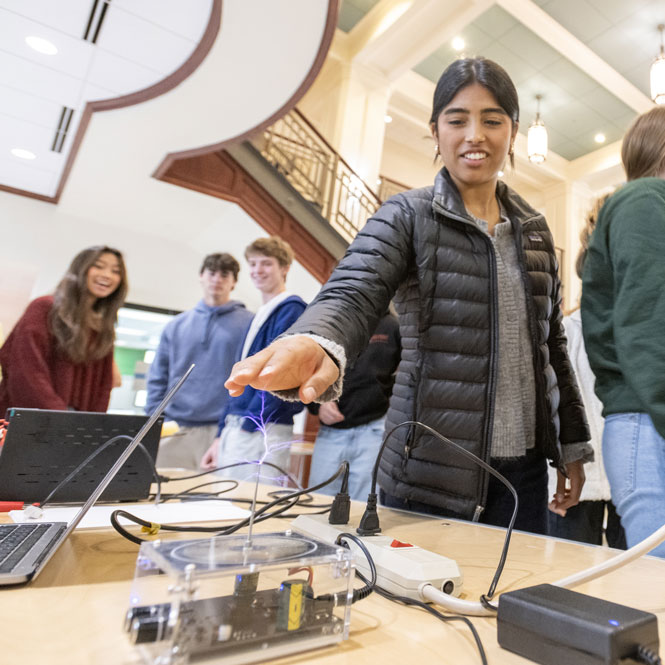


Faculty in the program have long approached their work with a sensitivity to the fact that their students are still at the threshold of adulthood. “From my work with the program, I gained an appreciation for the importance of the curriculum in transitioning students who arrive as high school graduates into successful college students,” said Leo McWilliams, the current assistant dean for undergraduate programs, who taught in the program for over 20 years.

As the program’s curriculum and guidance give first-years what they need to succeed academically, they are also encouraged to take their first steps toward becoming professional engineers, with responsibilities for leadership and decision-making.
According to Victoria Goodrich, a teaching professor and former director of the program, this reflects a deeply rooted institutional commitment. “The First-Year Engineering Program is a powerful example of Notre Dame’s mission to help every student flourish as a whole person,” Goodrich notes, explaining that by integrating technical rigor with teamwork, communication, and virtue, the college shapes engineers who graduate ready to serve as a genuine “force for good.”
—Karla Cruise, Notre Dame Engineering